
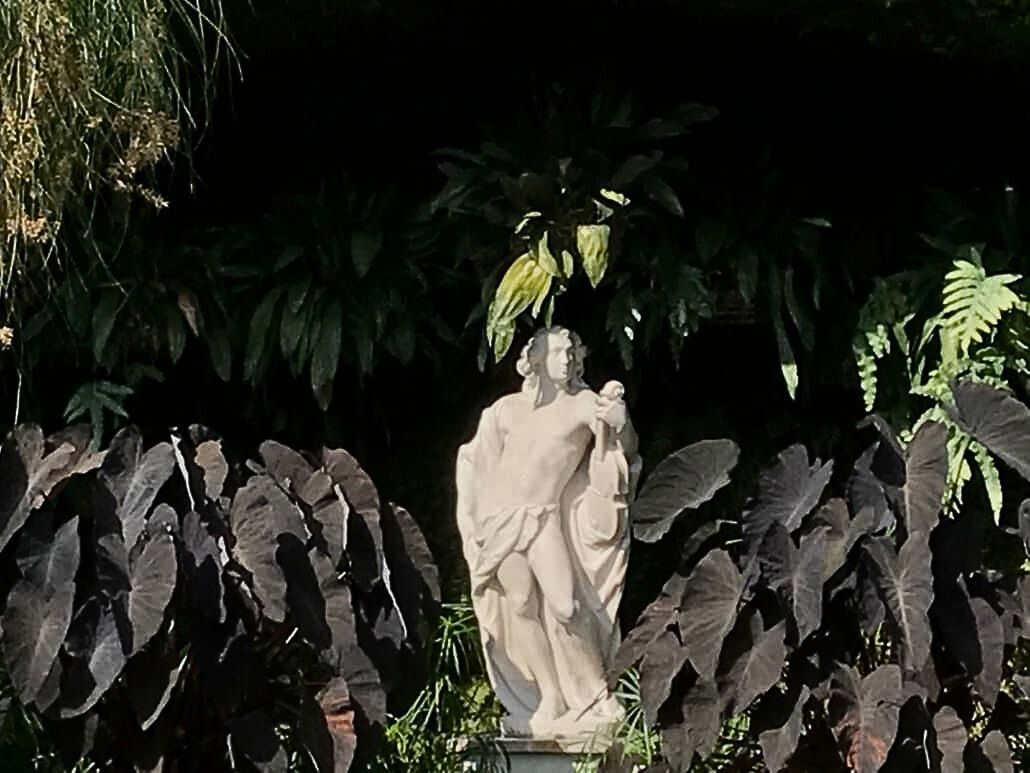
While we may be obsessed with death, that doesn't mean we can't cultivate a garden of living, breathing energy, comprised of the dark colors befitting a gothic home. Plants elevate the frequency of your home instantly. The effort and love you put into them, they return back to you.
Along with gathering together some of the most enchanting dark flowers and foliage on the Earth, their magical properties are included for any Witch wishing to incorporate these plants into their practice, with many offering protection and peace. Each is unique, eye-catching, and bound to feel right at home within your collection.
An important note: Be careful when buying plants and plant seeds. There are many fake AI plants out there, and those sellers will send you anything but what you bought. I have vetted all sellers I reference here, so that none of my gothic horticulture-loving readers get scammed.
Black Bat Flower (Tacca chantrieri)
Behold the Black Bat Flower, the gothic cousin of the Orchid. This alien-looking bloom features ghostly bracts, or 'wings', and is native to the southern parts of Asia. Such an unnatural specimen could easily be found amongst Morticia's garden!
Mystically, the Black Bat Flower symbolizes protection, as legend says a mystical creature once transformed herself into this flower to protect a village from impending danger. This unique botanical inspires hope, as those around it feel a guardian spirit watching over them.
To successfully cultivate the Black Bat Flower, it must be grown in a humid environment. These Fall-blooming flowers tend to thrive in tropical climates, such as Florida. Suppose you're familiar with caring for Orchids. In that case, you will find the care for the Tacca chantrieri to be quite similar, and you too can have possession of this infinitely mysterious flora.
⚠️ Mildly toxic to pets if consumed. ⚠️


Plant Care
- Plant in a wide, shallow pot with rich, well-draining soil. Sol Soils creates an ecologically-friendly Orchid Chunky Mix designed for these unique plants!
- If outdoors, place in shade. If indoors, place in bright light, though not direct, and mist consistently.
- Keep soil consistently moist.
- Fertilize with a soluble orchid fertilizer bi-weekly.
- Pest and disease-free.
Black Mondo Grass (Ophiopogon planiscapus 'Nigrescens')
The grass may be greener on the other side, but I'd rather remain where my grass is pitch black. Black Mondo Grass is an eerie type of foliage, like something you would see growing in the underworld of Tim Burton's Corpse Bride.
Spiritually, and more specifically in Feng Shui, this blackened foliage infuses space with yin energy, especially when placed in the Northeast direction. Under the Earth element, it symbolizes stability and dependability, and its alignment with the Gen Qi represents preservation and longevity.


Plant Care
- Plant in rich, well-draining soil, and space 3" apart for quick spread.
- In hot areas, plant partially in sun, but in Northern climates, plant in full sun.
- Keep moist, especially in climates with extreme heat.
- To keep grass tidy, remove old leaves in the spring before new blades emerge.
- Blooms July through August.
Black Rose Succulent (Aeonium arboreum 'Zwartkop')
A Black Rose by any other name would smell as sweet! Behold the Aeonium arboreum 'Zwartkop', an eye-catching succulent shrub with long branches that end in large, terminal rosettes of dark purple, almost black leaves. New growth arrives yellow, creating a gorgeous gradient from inner light to outer darkness.
The magical properties of the Black Rose Succulent include remarkable resilience, exemplified by its ability to thrive in harsh, cold climates (as low as -30ºF), and grounding energy, which comes from its deep, dark hue.


Plant Care
- Black Rose doesn't like hot or dry weather. May go dormant in summer.
- Doesn't require water except in very dry conditions, and in winter when soil feels dry.
- Keep the succulent in moist shade, and its true growth season is winter to spring.
- Fertilize with water-soluble 10-10-10 fertilizer diluted to 1/2 strength monthly from spring to fall.
- Spray with insecticidal soap or neem oil at any sign of aphids or pests. Repeat weekly until pests are gone.
Black Hollyhock (Alcea rosea nigra)
If Black Velvet turned into a flower, it would appear as the Black Hollyhock. The images do not do the plant justice, as its size is deceptively large. The hibiscus-like blossoms are 3 to 4 inches wide with satiny petals that range from deep maroon to purple to black. The sturdy stalks can grow 5 to 8 feet tall and do not require staking.
As a self-sowing plant, the Hollyhock symbolizes the circle of life, fertility, and abundance. The Black Hollyhock specifically represents mysticism and fairy life, where fairies were said to use the flowers as skirts.
There are no malevolent uses for the plant, and it is an excellent attractor of bees and butterflies, which will spread fertility throughout your garden. In a Witch's garden, Alcea rosea nigra instantly belongs.


Plant Care
- Biennial with a summer and fall bloom; frost hardy.
- Plant seeds in full sun in garden soil in spring, 1/2 an inch deep, 6 to 8 inches apart. Keep moist until germination; this is the easiest way to grow the plant.
- After blossoms fade, cut off spent flower stalks just above the ground.
- Fertilize well and water as needed.
- Susceptible to slugs, snails, and fungus.
Black & Purple Shamrock (Oxalis Triangularis)
For the purple-loving goths (my people), the Black & Purple Shamrock would be the perfect addition to your home. Its dark foliage builds upon itself, growing to 20 inches tall and broad. The leaves of this plant mimic those of bat wings, folding in at night or when disturbed. Like many of us, the Shamrock will also retreat when exposed to harsh sunlight.
Oxalis Triangularis is steeped in symbolism. Any three-leaf plant is connected to St. Patrick, bringing luck and prosperity. The leaves also resemble a heart, echoing themes of love and fertility, making them a meaningful gift between partners.
⚠️ Toxic to humans and animals if consumed. ⚠️


Plant Care
- Indoor or outdoor, as long as the plant can get four hours of direct sunlight each day.
- Water whenever the well-draining soil is dry.
- Fertilize during growing season (fall to spring); refrain from feeding when the plant is dormant.
- When indoors, rotate the houseplant to prevent it from becoming leggy.
- Enjoys moderate temperature and humidity.
Black Lace Elderberry (Sambucus nigra)
A magnificently dramatic perennial shrub, I can see two Black Lace Elderberrys flanking the walkway leading to a Pastel Goth's front door. With purple-black foliage and pink flowers, it can grow to an astounding 6-10 feet tall/wide. Tiny white flowers bloom in June and July, which then give way to clusters of glossy black elderberry fruits in late summer.
Elderberry symbolizes advancement, progress, ambition, and that which creates fortuitous conditions. Use it to raise your confidence to the level you need to accomplish your goals and find success. Elderberry tea has even been used to invoke astral travel!
⚠️ Most parts of this plant are toxic to humans and animals if consumed. Cooked berries and fresh flowers are safe for human consumption. ⚠️


Plant Care
- Grow in medium to wet, well-drained soils in full sun to part shade, but best in full sun.
- Prune out dead or weakened stems to preserve desired appearance.
- Self-pollinating, but can increase fruit yield by planting more than one cultivar together.
- Not invasive, but spreads quickly. Regularly remove suckers to keep it from spreading.
Black Magic Elephant Ear (Colocasia esculenta)
A bold addition to your goth garden would be the Black Magic Elephant Ear. Should any of your plants require shade, simply plant them nearby. This perennial can grow 3-6 feet tall and wide, with "huge, heart-shaped to arrowhead-shaped, conspicuously-veined, downward-pointing, peltate leaves (to 2' long) on long, stout, succulent stems."[1]
As for Colocasia esculenta's magical meanings, it is a symbol of strength and resilience due to its long tenure in gardens, from ancient to modern times. Additionally, Elephant Ear plants are aligned with the element of water, symbolizing intuition, healing, and emotional wellness.
⚠️ All parts of the plant are poisonous to humans, livestock, and pets ⚠️


Plant Care
- Water deeply until water drains. Only water when the top two inches of soil are dry. Do not allow soil to fully dry out.
- Fertilize with a liquid fertilizer once a month during growth period.
- Sunlight lover; inside needs 16-18 hours of light (can be artificial), outside needs 12-14 hours of light.
- Indoor temperatures should remain between 65-75º.
Black Hellebore (Helleborus hybrids)
A flower that blooms in winter with the darkest of petals is the Black Hellebore. For all its gorgeousness and romanticism, this deceiving beauty is full of toxins. Once used by the ancients to treat insanity, gout, and epilepsy, it is now known to cause tinnitus, vertigo, emesis, catharsis, collapse, and death. That is only a few of the symptoms.
In folklore, the Black Hellebore was used in protection spells to ward off evil witches, while at the same time, it was believed to be wielded by those very witches. Its magical properties beyond protection include purifying spaces, enhancing psychic abilities, intensifying love and attraction spells, and banishing unwanted energies or spirits.
⚠️ Witch be wary; work with the Black Hellebore with caution, and do not injest. ⚠️


Plant Care
- An incredibly easy flower to grow and care for.
- Evergreen perennial; Drought-tolerant; Salt-tolerant.
- Keep in part shade to full shade.
- It can grow in any soil, but will thrive in a well-draining soil.
- Provide good air circulation and avoid overhead watering to prevent any pest botherances.
Etna Begonia (Begonia rex)
With its enchanting name and spell-binding physical beauty, the Etna Begonia can be imagined as the favorite foliage of the Vampire, reminding them of the living pulse of crimson blood they must live on. Similar to the fanged creature, the foliage of these plants could burn if exposed to excessive direct sunlight.
Vibrant even in darkness, this cultivar does best through indirect light, such as numerous candles placed throughout the room. A magnificent addition to your gothic garden, the Etna Begonia will add a fiery touch, breaking up any monotony, and is equally fitting given Begonia's spiritual significance: balance.
⚠️ Toxic to pets ⚠️


Plant Care
- Best with bright, indirect light. Place away from a window or surround in candlelight.
- Water with 1 cup every 9 days.
- Any potting soil will suffice.
- Repot after it doubles in size or once a year.
- Do not grow in overly hot conditions.
Ghost Euphorbia (Euphorbia lactea)
Would you like to add another ghost to your haunted home? I bet you didn't know you could do so in cactus form. This strange, spindly plant is a native to arid and subtropical regions of South Asia, but looks like it belongs amongst hours of fallen white snow. Its appearance is said to create a barrier against negative energies, warding away that which wishes to cause you harm.
As a houseplant, Euphorbia lactea reaches heights of about 1 to 3 feet, with spring-blooming flowers in yellow-white or greenish-yellow hues, surrounded by colorful bracts of white, green, and even pink, giving it a look that can only be described as otherworldly.
⚠️ Mildly toxic to humans and animals if consumed in large amounts ⚠️


Plant Care
- Requires 6+ hours of full sun when outdoors and 4-6 hours of bright, indirect light indoors.
- Water every 2-3 weeks during growing season when soil is 100% dry, and once a month during dormancy.
- Use a Cactus Gritty Mix Soil and fertilize with Succulent & Cactus Plant Food once a year in spring.
Ferox Begonia (Begonia ferox)
Here we have another Begonia, but this one comes with black, defensive spikes that cover the broad leaves of this succulent. Reminiscent of the Upsidedown from Stranger Things, the Ferox Begonia is an alien with a creeping growth habit, with leaves up to 7.5 inches long and 5 inches wide.
The Latin Ferox translates to fierce-looking or wild-looking, and the Ferox Begonia doesn't disappoint. Despite their sharp appearance, the spikes, called bullae, are smooth to the touch. Such an interesting specimen would be a welcome addition to a garden dedicated to the strange and unusual.
⚠️ Toxic to pets ⚠️


Plant Care
- Does best in high humidity, so place in bathroom or kitchen, as long as sunlight is also accessible.
- Use potting soil that's rich in organic matter and slightly alkaline, like this Begonia Potting Mix.
- Place 1-3 feet from an east- or south-facing window for indirect sunlight.
- Water often, keeping soil evenly moist, but not waterlogged. Can be best to water the substrate from below with a tray of water underneath.
Verrone's Obsidian (Dahlia)
Cosmic and striking with a delicate, dark beauty comes Verrone's Obsidian, also known as the Orchid Dahlia and the Star Dahlia. When it comes to dahlias, star-shaped flowers are seldom found, making the shape rare and eye-catching. This flower embraces the dramatic, with a bright yellow center that contrasts sharply with violet, almost-black petals.
The Star Dahlia is a perennial with a bushy, upright growth habit and fits in well with various garden compositions. It can reach up to 36 inches in height and spread around 18-24 inches overall, depending on conditions. Those who gaze upon your garden would be remiss not to mention the beauty of the Verrone's Obsidian, for no other flower can come close to its majesty.
⚠️ Toxic to dogs, cats, and horses ⚠️


Plant Care
- Requires 6-8 hours of direct sunlight daily.
- Prefers well-drained, loamy soil.
- Needs consistent moisture; water deeply a few times a week.
- Use a well-balanced, low-nitrogen fertilizer.
- Plant in the spring, about 4-6 inches deep in the soil.
Ghostly Caladium (Caladium bicolor)
Here we have another creepy white addition, the Ghostly Caladium. A cousin to the Black Magic Elephant Ear from above, intense contrast could be brought to your goth garden by placing the two adjacent to each other, like a chess match in plant form.
When young and growing, the leaves of Caladium bicolor are primarily green, with white veins. As the leaves mature, the white slowly takes over the majority of the large leaf, creating labyrinthine patterns throughout. Spiritually, Caladiums represent purity and peace, and serve as cleansers of a space's energy by absorbing the negative and attracting the positive.
⚠️ All parts of the plant are poisonous to humans, livestock, and pets ⚠️


Plant Care
- Grow in moist, fertile, humusy, organically rich, acidic soils in part shade. Avoid direct sun as leaves will scorch.
- Water regularly to keep soil slightly moist but not saturated. Add mulch to help retain soil moisture.
- Best in warm environments that do not drop below 60ºF at night.
- If not looking good, use a 12-6-6 fertilizer every 6 weeks during growing season. Otherwise, for potted plants, use a 15-9-12 fertilizer once at the beginning of growing season.
May your gothic garden flourish with immense dark beauty this upcoming year!
~With Love, Beatrix Devine



.jpg)